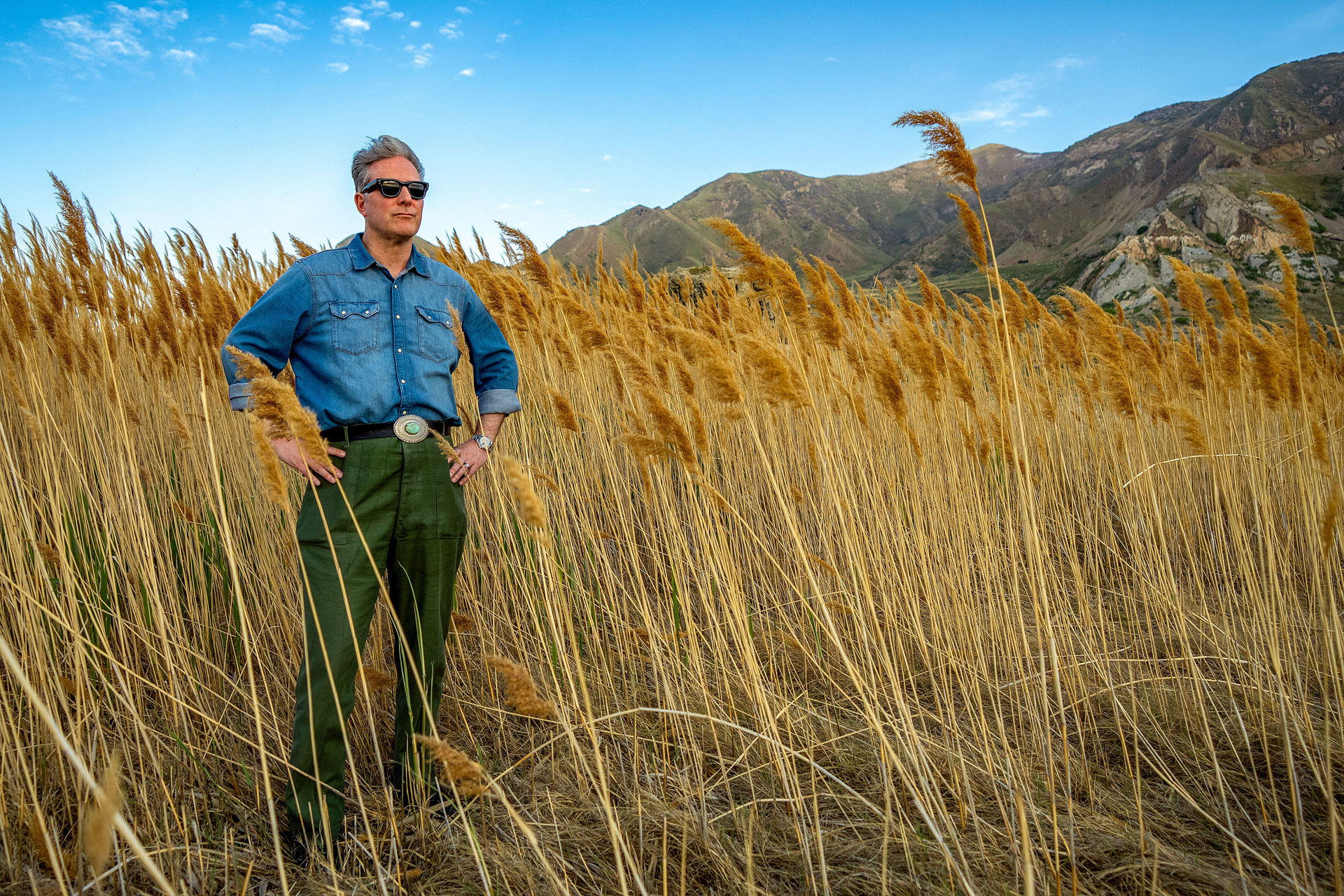
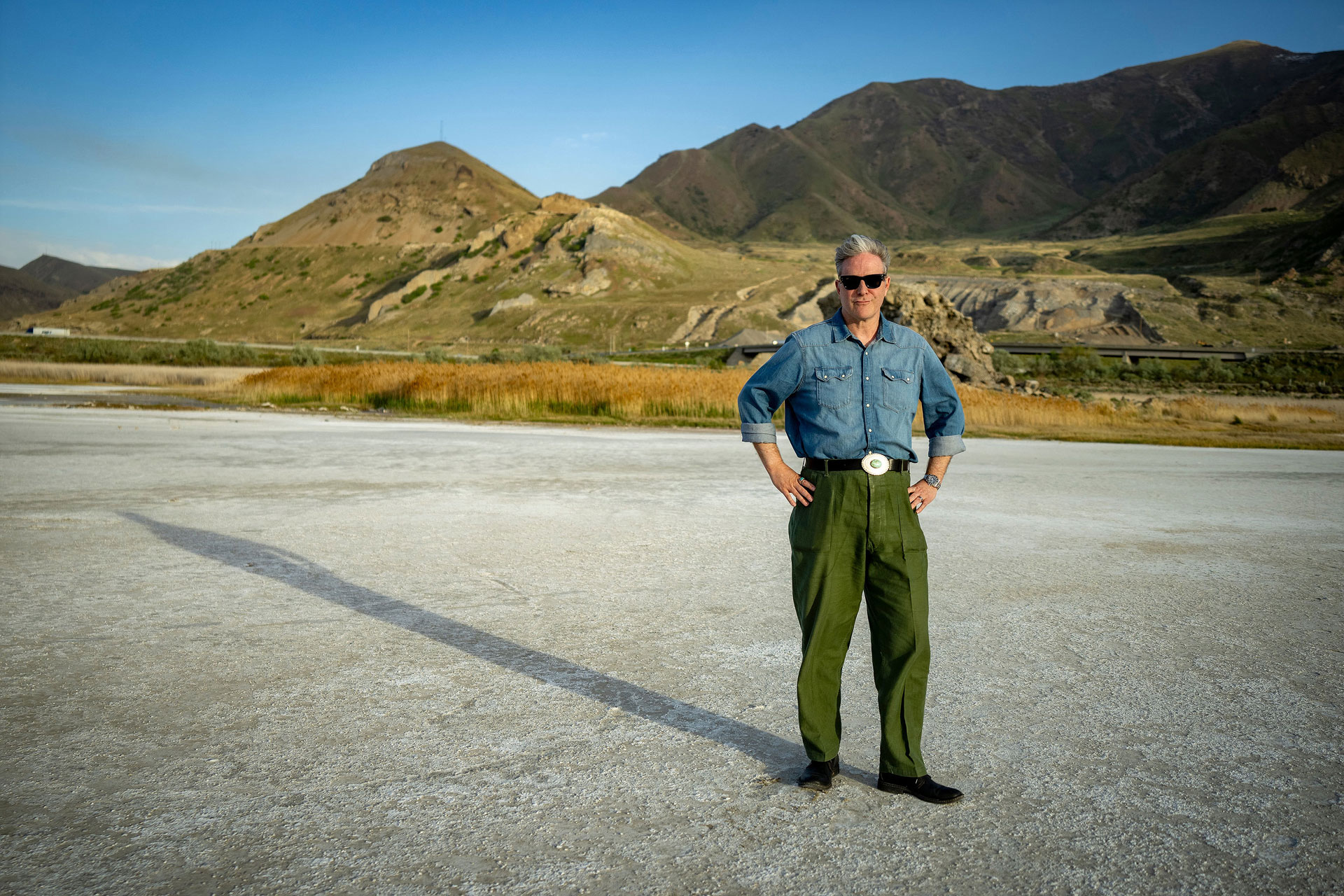
Chris Carlson is neither scientist nor scholar, but there may be few who understand the Great Salt Lake the way he does.
For him, the lake is a sanctuary and he is a reverent devotee. It’s a place tied to his ancestors, somewhere he has turned for answers during the most difficult times of his life. It’s a place that has both inspired and confounded him.
From behind a camera lens, Carlson has documented every aspect of the lake over the last decade. He can tell you all about the reflective waters of the South Arm, the industrial operations along the shoreline and the wildlife that relies on the terminal body to survive.
“I have almost an endless fascination with it,” Carlson said.
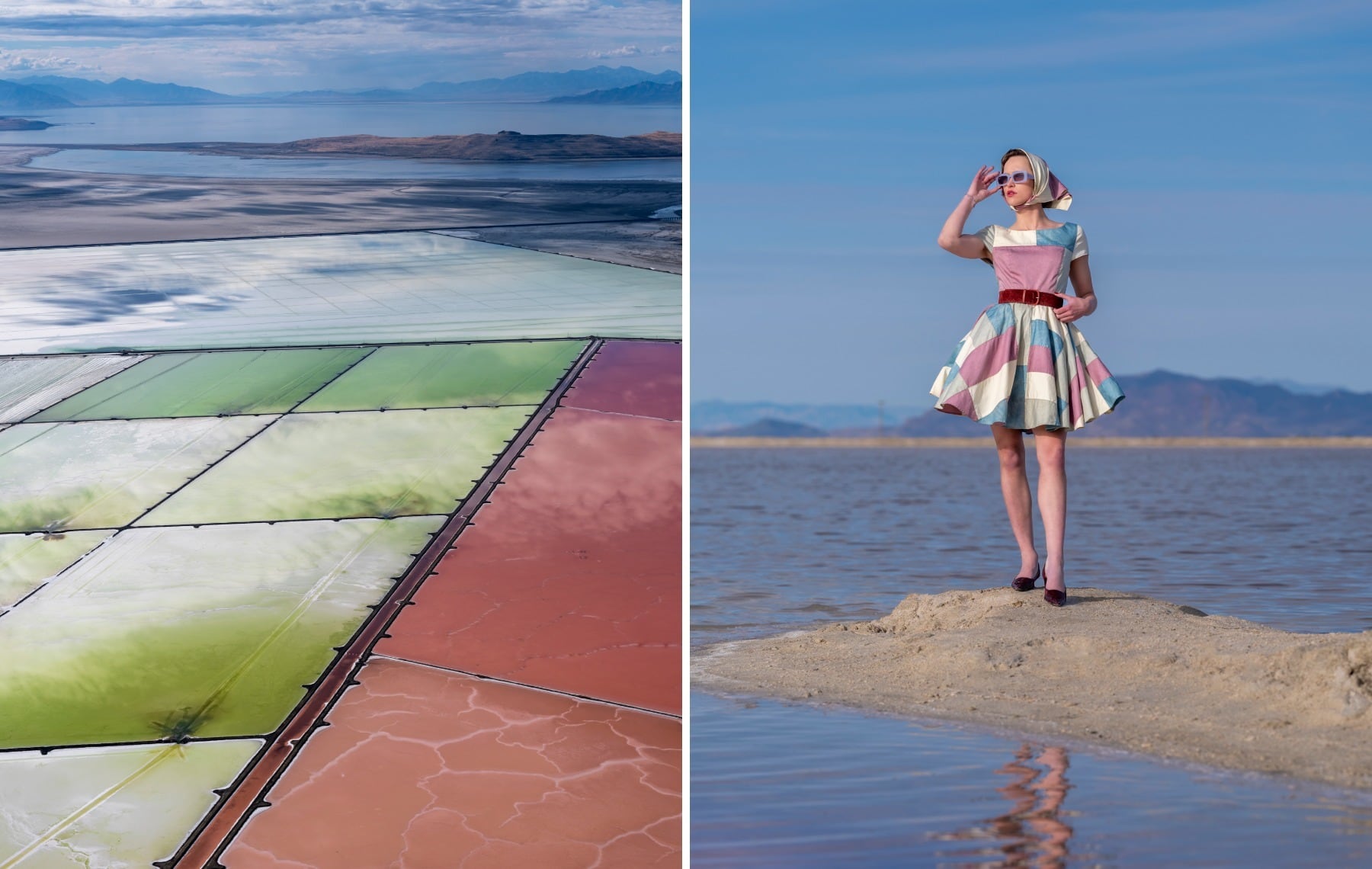
It’s even trickled into his dreams. As Carlson slept one night nearly two years ago, he saw the evaporation ponds along the lake morph into a dress by Yves Saint Laurent. It was the famous 1965 Mondrian dress. Only instead of bold red and blue blocks, Carlson saw lime green and pale pink, colors of Compass Minerals’ operations.
He woke and grabbed the sketchbook next to his bed.
“I just started drawing out all these looks that could be inspired by the lake,” Carlson said.
Those sketches became a concept called GSL Luxury — a fashion advocacy project for Utah’s largest body of water. Through the designs, Carlson is hoping to get people to care about the lake as much as he does.
“What if we value Great Salt Lake with the same fervor that we value the logos that we wear? What if saving it became the ultimate expression of sophistication and care?” Carlson pondered.
‘Charts don’t change hearts’
Carlson’s connection with the lake was forged through generations. His fourth great-grandfather is Fielding Garr — of the Fielding Garr Ranch.
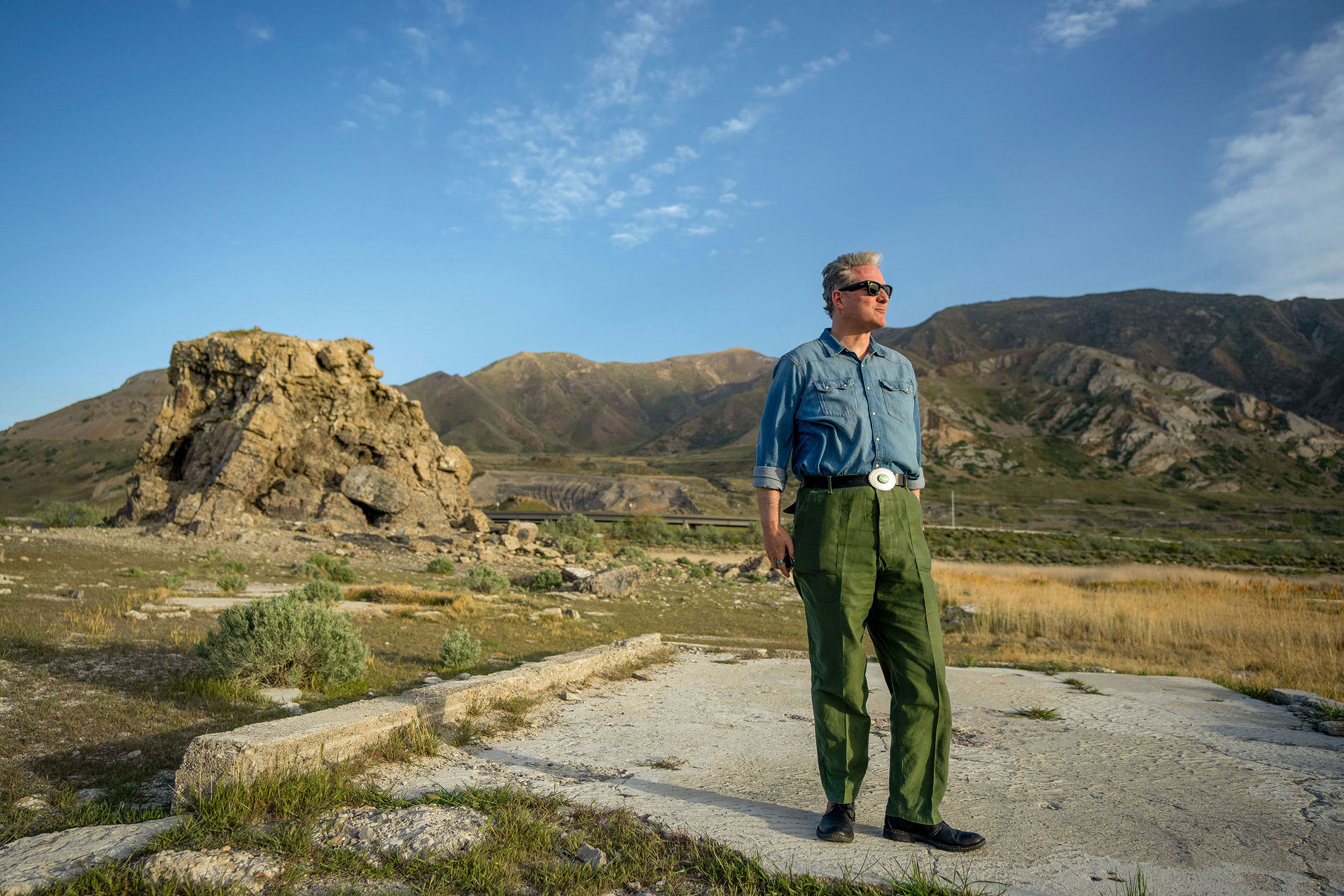
Carlson, a board member of Grow the Flow, lives 10 miles from the gate of Antelope Island, the place where he feels “the most at home.”
“I can go out to Antelope Island and I can find answers to any question that I want,” Carlson said. “It’s my place where I can have therapy.”
He did just that as he watched Alzheimer’s take his father three years ago.
“Great Salt Lake became this place for me where I could go out and kind of find answers to my deeper spiritual questions about why this was happening to my father,” Carlson said.
He watched the salty water wane, declining like his father’s health.
“I started to think just like my dad’s memories are leaving him, we’re going to forget about this lake, because we’re losing it. It’s just becoming smaller and smaller,” he said.
So, he made it his mission to document everything. His photography book, “Preserving Greatness,” released last year and is full of bright, bold images.

As someone who has been keyed into the lake’s diagnosis, he also knows that getting people to care about it is difficult.
“A lot of times we put numbers and data in front of people around the lake, but it just doesn’t quite have [an] impact,” Carlson said. “I always say that charts don’t change hearts.”
But, he’s hoping stories — and fashion — can.
“If I was telling you about this bird and I told you his name was Henry and he lived on the south end of Antelope Island and he has a family, you’ll be much more interested in the story than if I said, ‘There’s thousands of Northern Shrikes that live around Great Salt Lake and they rely on the lake for their survival,’” he said as an example.
Local designers
Carlson has never been a fashion designer, so he recruited help after he dreamed about a piece of the lake turning into a piece of luxury.
He met with Utah State University professor Melissa Clark and showed her his sketches. Now, 20 different student designers from USU and Salt Lake Community College are a part of the project. Each student submitted a proposal based on his photographs, and Carlson took on the role of creative director, helping them tailor the designs to match what he captured.
Every student has a budget of $1,000, though there’s wiggle room here and there because Carlson encourages the students to use natural fibers. He also set up a nonprofit — Future Folklore — to help raise money to pay the students. So far, he said he has used all the proceeds from his book, and $15,000 of his and his wife’s money, to pay the students.
“For me, it’s just necessary to keep the lake in the conversation, regardless of the personal sacrifice,” he said.
Clark said the project has provided her students with a unique opportunity.
“They’re getting to work with high-end materials that they wouldn’t usually [use],” she said. “It’s really given them a chance to experience fashion at a different level.”
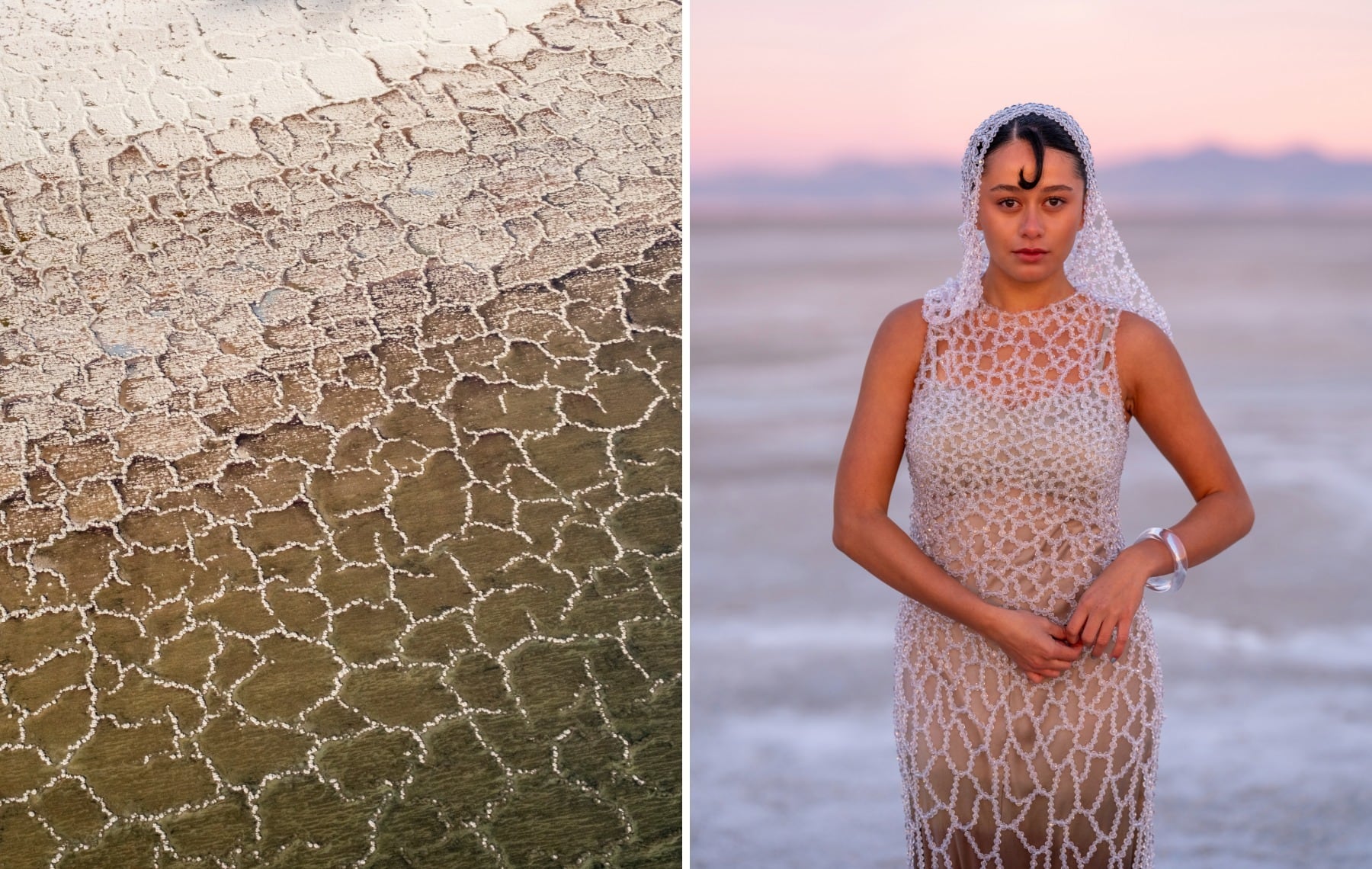
She’s designing a look for the collection called the Cracked Coastline Gown, which is inspired by the rare, bright white salt mounds that form along the Great Salt Lake during the winter.
Clark started by making the underdress to support the layers of beading on top. It’s a simple, silk charmeuse slip dress with an ombre effect to reflect the colors of the coastline. The overlaid beads were carefully chosen to reflect the salt crystal formations.
Through this project, she said she hopes people can see the beauty of the lake, and connect with the collection’s overall message: “It’s not a luxury and it’s an essential.”
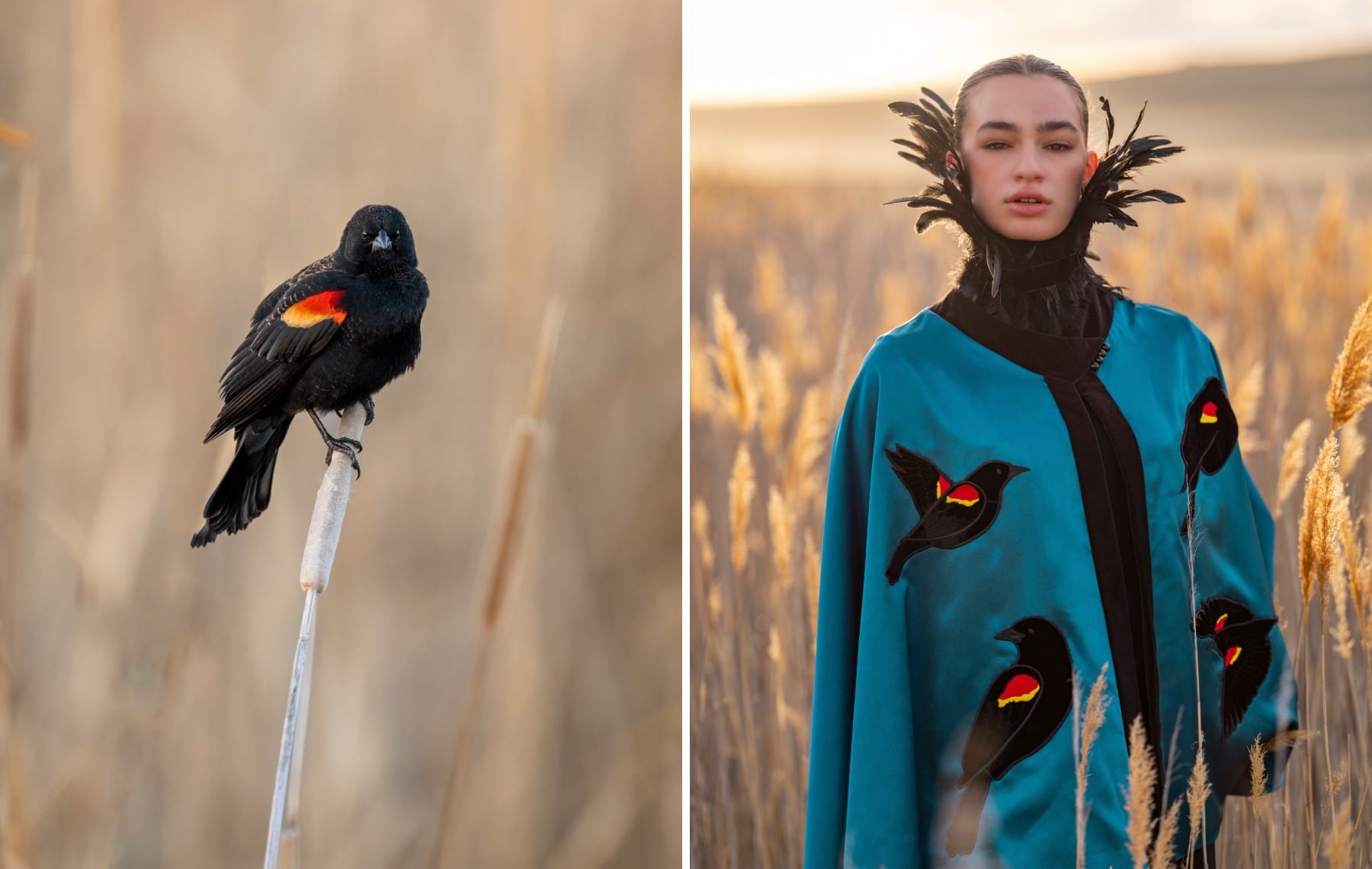
Other pieces in the collection are inspired by the birds who frequent the lake and other landscape aspects.
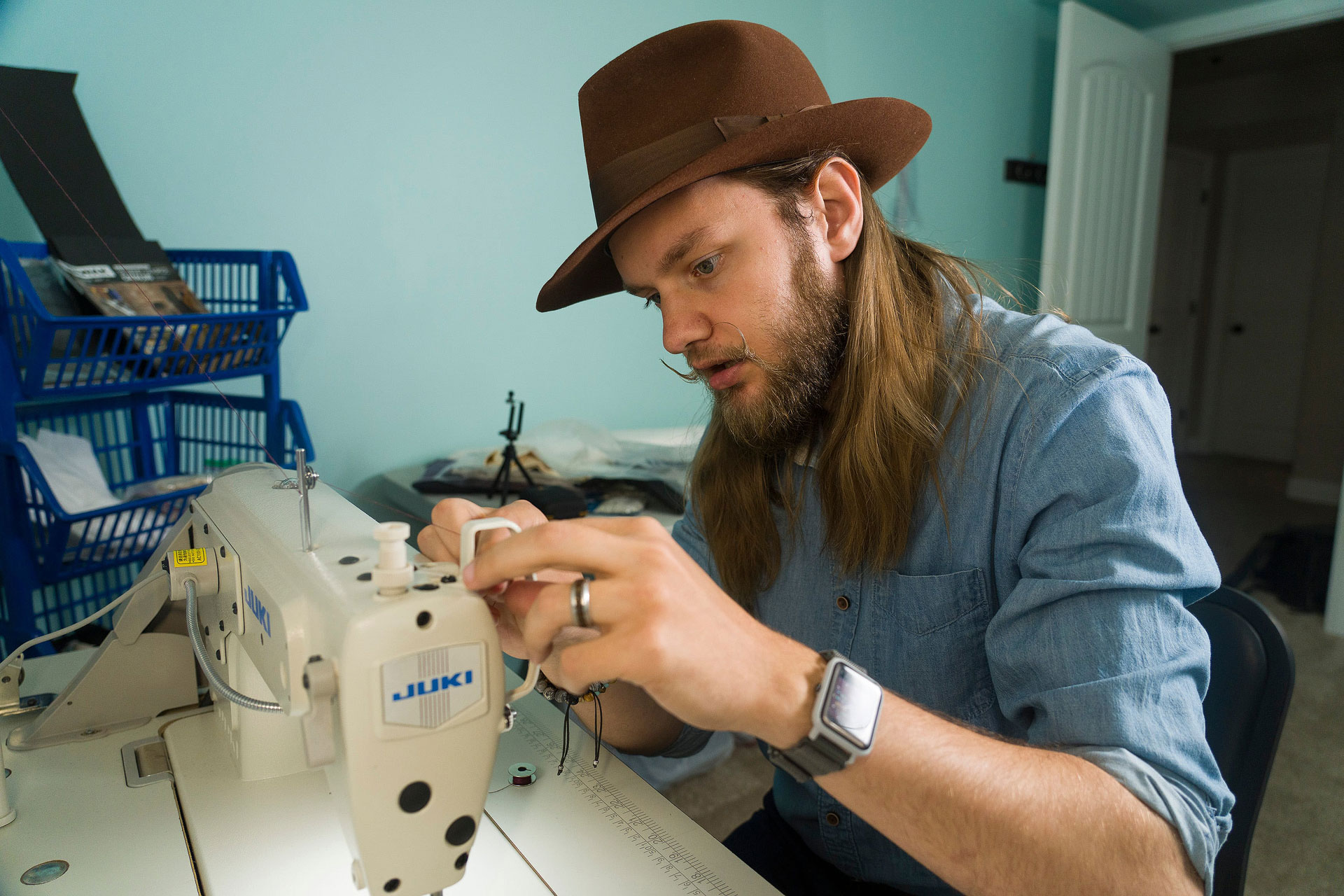
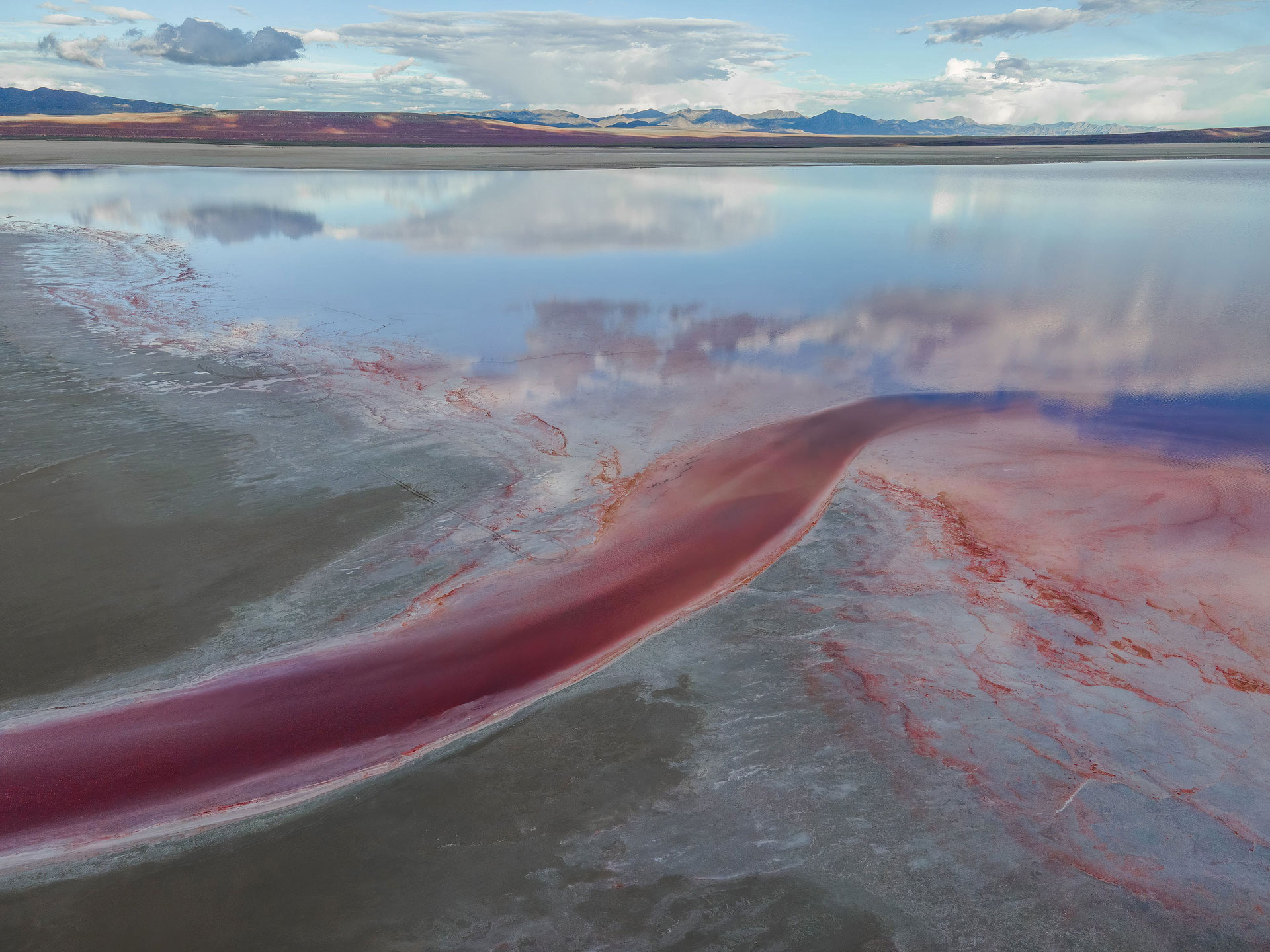
Utah State student Joseph Raff designed the North Arm Suit, a tribute to an area of the lake where there’s deep red or pink-colored water due to extreme salinity and to the white crystallized salt that forms on the surface.
“I wanted to try and figure out different ways of combining that crystalline, rough, coarse texture with the smooth, ripple and organic feel that you get from the natural movement of the water,” Raff said.
The suit features a silk and rayon velvet jacket with a low break point, accented with seed and bugle beads to mimic the texture of the salt. The pants are white with a red stripe down the legs and made of a silk woven in a herringbone pattern.
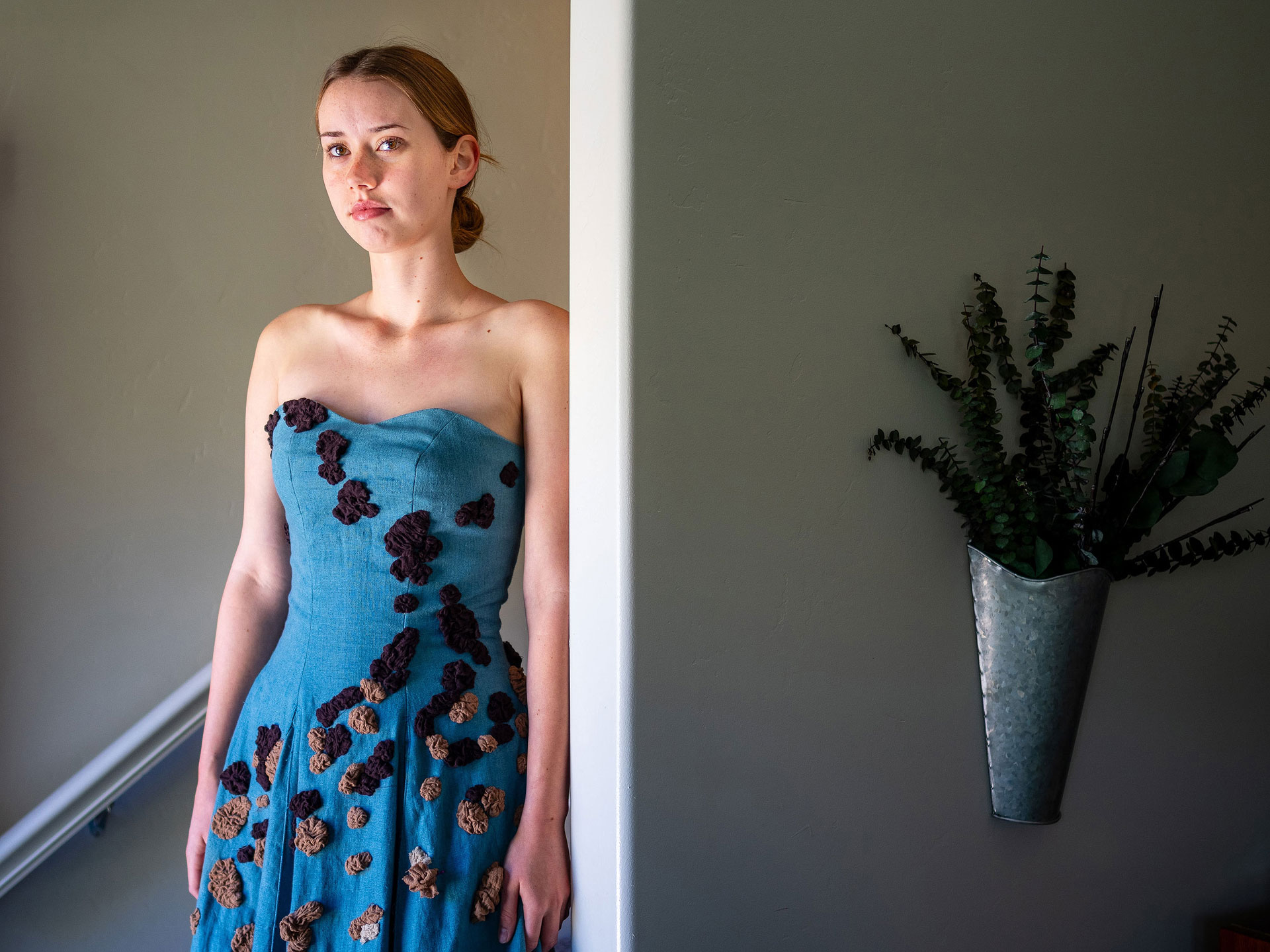
Ysabel Birmingham is paying tribute to the Great Salt Lake’s living rocks — microbialities — with her gown.
Before this, Birmingham had never heard of these mineral deposits that produce oxygen. The curious little formations posed a creative conundrum for her. Now, she’s making around 400 replicas of them for her gown.
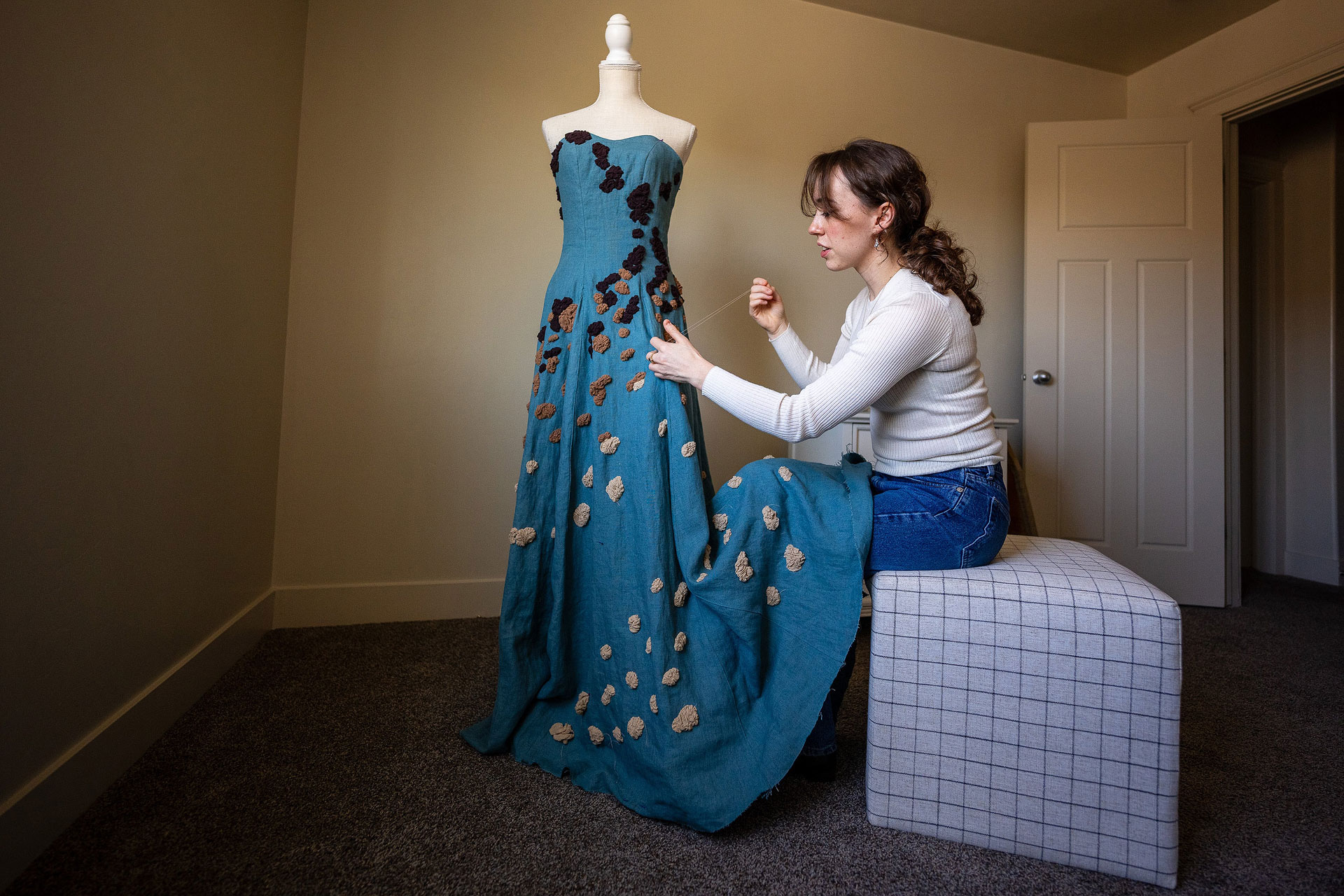
“What I decided to kind of portray in the dress was that as the water line recedes from the Salt Lake, the microbialites die, and they kind of dry out and turn this very light tan color,” she said. “The dress will be a cascade of microbialites, from the ones that are alive and like deep brown under the water to the ones that are dead.”
The plan is to stitch the shapes together to recreate the rock formation, utilizing a fabric manipulation technique.
Birmingham graduated from USU last spring with a degree in history and fashion. But this project has been a learning opportunity that goes beyond the fabric and thread.
“I didn’t realize before I started this project how much life there is around the Salt Lake, because people just talk about it like it’s kind of dead,” Birmingham said.
GSL as a necessity, not a luxury
Carlson’s sister, Samantha Lee, is the project’s creative partner. She immediately jumped on board after hearing her brother’s dream. She helps as a sounding board and stylist.
“My biggest takeaway is encapsulated in the name of our project. Great Salt Lake is not a luxury,” Lee said. “We as Utahns absolutely take this lake for granted. We don’t really understand what it means to our state.”
Working on the project alongside her brother, Lee said she’s learned that the lake is, instead, a “necessity.”
“As citizens of Utah, we have to advocate for it,” she said. “[Chris] is so invested in the lake and wanting to save it.”
The final designs will be shown at a fashion show on Nov. 14, at This is the Place Heritage Park’s Pioneer Center.
Ultimately, Carlson hopes to raise $200,000 from sponsorships, 15% of which will go to pay the student designers and 85% of which will go back to the lake. The George S. and Dolores Doré Eccles Foundation recently became the presenting sponsor of GSL Luxury.
Carlson also hopes to find a place to donate or exhibit the finished collection.
Whether through fashion, photography or stories, Carlson said dedicating his life to increasing awareness is for “a future in Utah for young people and kids.”
“I know enough about the lake and I’ve spent enough time looking at the science, that if we let Great Salt Lake disappear, we won’t be able to live here anymore,” he said. “It’s the scariest kind of existential crisis facing people here in Utah.”
Carlson wants to save the vital ecosystem for the millions of birds that depend on the lake. He knows the lake is the reason the Beehive State is home to the greatest snow on Earth. He knows the lake supports billions worth of economic activity.
“When you add all that stuff together, for me, it’s like, why wouldn’t I spend my time on it?” he said.
This article is published through the Great Salt Lake Collaborative with funding from Love the Lake, an initiative of the non-profit Great Salt Lake Alliance. Editorial decisions are made independently by the Collaborative and partner newsrooms.