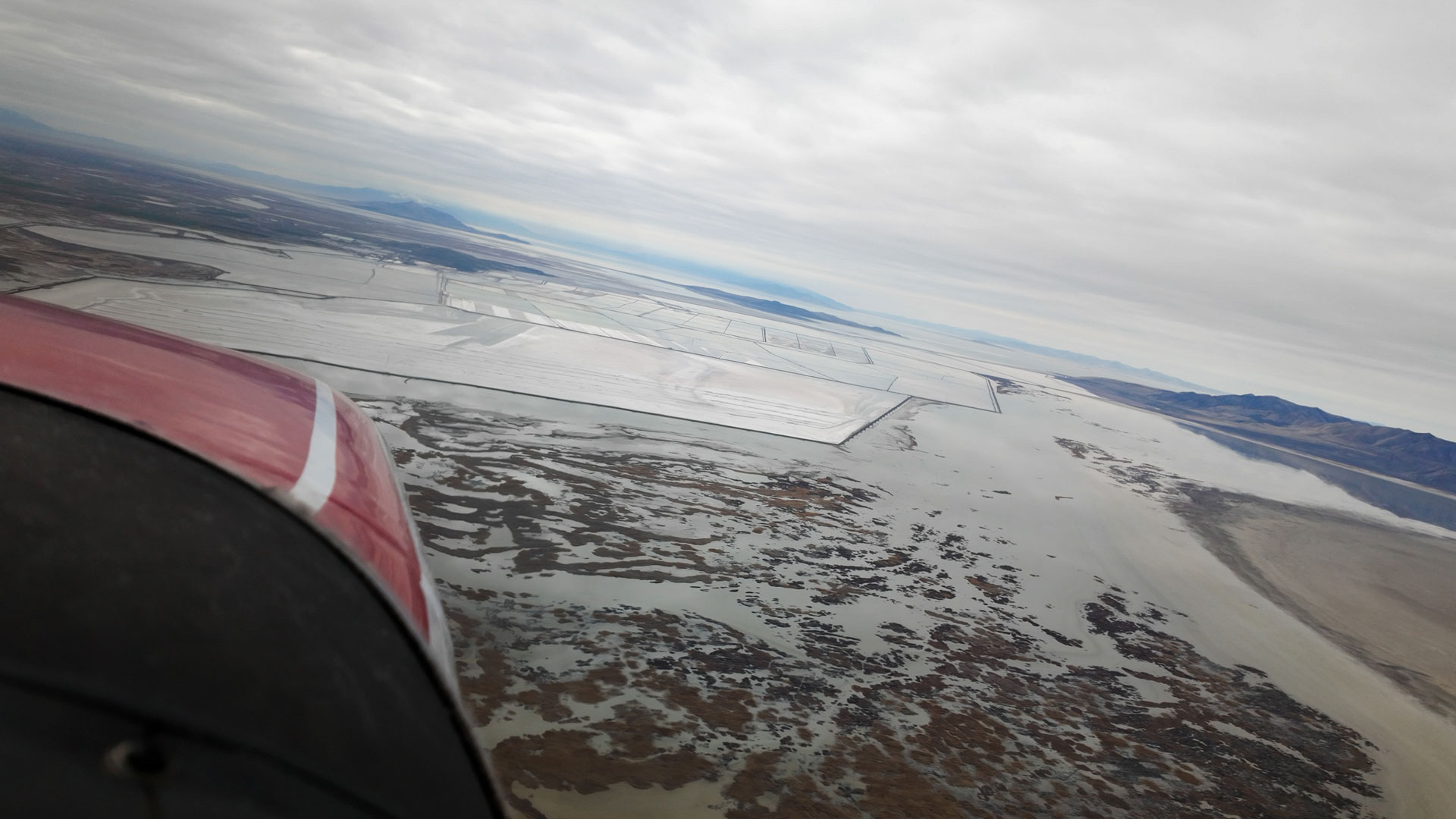
The plane banks left. Below, the Great Salt Lake stretches to the horizon, pale and flat until under a gray March sky. From the ground, you can’t see the dry lakebeds, the bathtub ring of white mineral crust, the rivers that stop before reaching the shore.
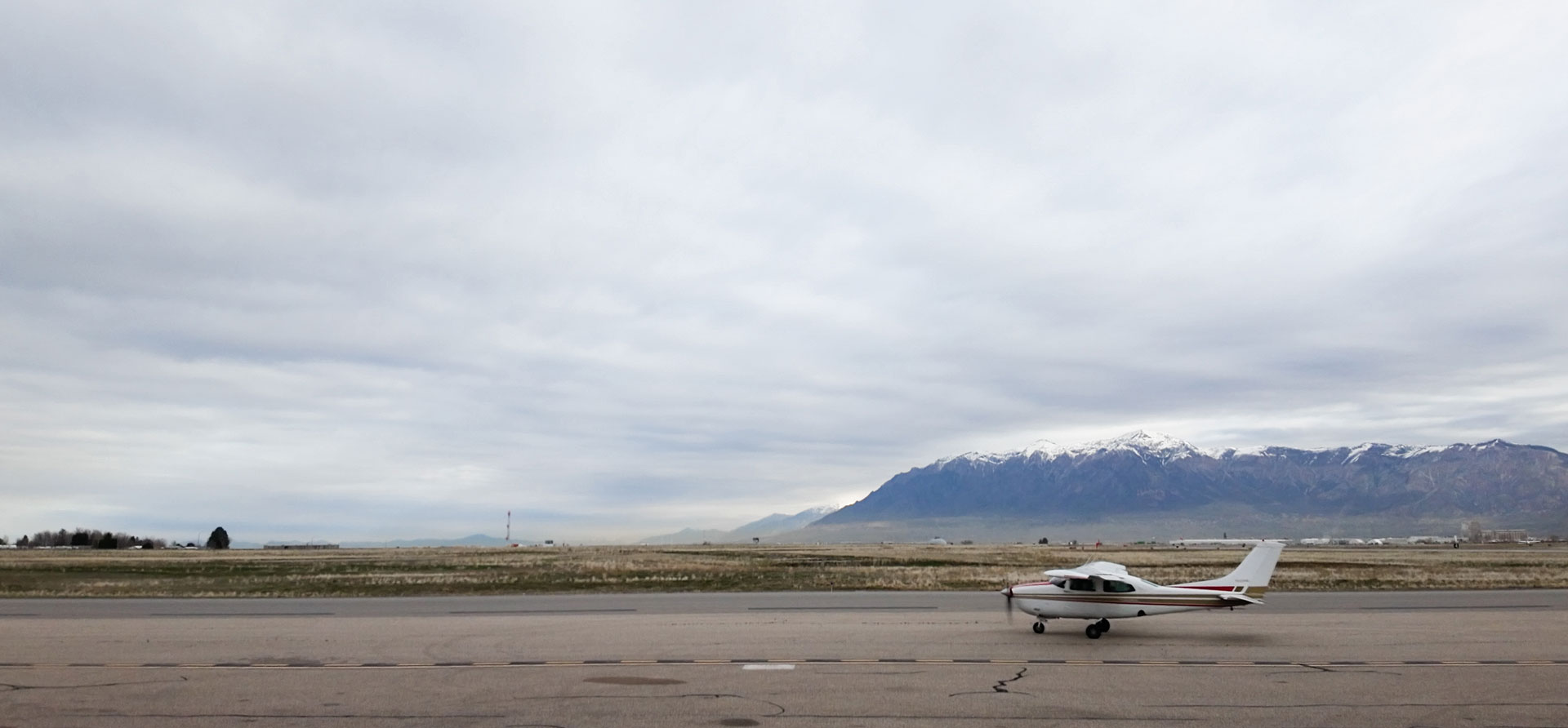
On March 16, a small plane of Utahns lifted over the Wasatch Front. In collaboration with EcoFlight, the environmental organization Friends of Great Salt Lake hosted a group of educators, scientists, tribal elders, researchers and advocates, taking in the lake from new heights.
Kelly Hannah, Friends’ board president, said Utah has “a giant web of organizations” committed to environmental issues. The group takes the pressure off Utahns to save the lake alone, he said. “Everybody touches that water in a little bit of a different way,” Hannah said.
The lake from above
EcoFlight, a nonprofit based in Aspen, Colorado, teams pilots with environmental and conservation advocacy groups around the country. According to Friends’ Community and Outreach Director Katie Newburn, much of EcoFlight’s work gets different advocacy groups to talk to each other about the problems they’re trying to solve.
“There’s a lot of insight to be gained from comparing,” Newburn said.
Watch: Low Pass Flight Over Great Salt Lake
Newburn said the flights often reveal the lake’s worsening problems. “Some years we fly over this same route, and the river literally ends before it crosses under the train trestle into Gilbert Bay,” she said. “That’s a pretty visible piece of evidence that tells us this is an insufficient amount of water for this system in a given year.”
Maria Moncur, who is communication & PR director for the Northwestern Band of the Shoshone Nation, also attended the second flight. She described the aerial view as an “amazing perspective” of the lake that she doesn’t see at ground level.
“It’s weird, because it does feel like the lake has more water there than it really does,” she said. “It’s interesting to see the different colors, the contents of the lake, and whether it’s heavy on brine shrimp and where it’s heavy.”
Hannah described the experience as a “profound difference in feeling and sensibility” when looking down, seeing the scale of the lake, the dry lake beds and the rivers.
“The flight exists to raise awareness of Great Salt Lake from a perspective that most people don’t see,” he said.
Major goals
According to Salt Lake County, the effective area of the Great Salt Lake Basin is approximately 21,000 square miles, with its four major sub-basins encompassing 34,363 square miles. The basin connects more than 2.5 million people who affect — and are affected by — the lake’s ecosystem.
Newburn said Friends prioritizes water quantity, water quality and development or encroachment around the lake. However, when the lake water level approached its record low in 2022, the group’s primary concern became water quantity. “Our hope is there will be consideration for the lake and our responsibility to take care of what’s downstream of us across that whole area,” Newburn said.
The organization has pursued water leasing, legal action against government departments, new water rights applications for groundwater and wastewater reuse. Additionally, a team of scientists contracted with Friends is testing selenium concentrations, sampling groundwater and bird eggs in the area to identify sources of contamination.
“This year will be a telling one for how much our state and how much our community members are willing to do on behalf of the lake in terms of water conservation,” Newburn said.
Public policy and education
After 30 years of Friends’ advocacy, Hannah said the organization has “exponentially” grown relationships with community leaders, legislators and executives — without changing its core principles.
Hannah cited the Utah State Legislature, with whom Friends works regularly, for its work toward saving the lake. “Over the last several years, [the Legislature] passed some very important legislation to get water to the lake, and it’s not enough,” he said.
Tina Bagley, an educator from Salt Lake City and community advocate, said any grassroots environmental work must begin with young people.
When Bagley was growing up, she said, Utahns rarely regarded the lake positively; now, with education programs, “the public’s consciousness” shifted to understanding the lake as a “treasure.”
“That kind of the bubble has burst a little bit in people’s minds about [the lake]; we just don’t take it for granted,” she said. “The way you get to change is through kids. Because if you don’t grow up loving it, you don’t really have a connection to it.”
Newburn touted Friends’ fourth-grade field trip program as a step towards securing the lake’s future. “Certainly, education and reaching youth is this long game in the mission to restore the lake,” she said. “Those children who grow up around the lake will become decision makers. If they don’t have a relationship with the lake, how are they supposed to know how their decisions affect it?”
Ways of life
Rios Pacheco, a tribal elder and cultural advisor of the Northwestern Band of the Shoshone Nation, said the lake has long been important to his community’s way of life — and pollution and industries have shifted his tribe’s daily life.
“The quality of water goes back to having all types of pollution. Many people use the water, and mostly the animals, because now we have domestic animals coming in,” Pacheco told The Daily Utah Chronicle. “But before with the other animals, the pollution could be caught in those labor dens and then it filtered out. … The water was more clear.”
Pacheco, who lives around the Bear River, said the land was relatively “undisturbed” until after the Bear River Massacre in 1863. After that, he said, more settlers arrived in search of income, followed by police and industry. “Now [the bay] is just industry with housing areas,” which has resulted in unmanaged algae growth, dust storms and other environmental effects.
“We’re not patient through that process,” Pacheco said. “There are too many people coming in, living in the wetland area where the water would have come and been filtered out. But because they’re using the water before it gets to the area, chemicals come back into the river.”
It takes a team
According to Newburn, a “huge part” of the mission to restore the Great Salt Lake is to “shift the cultural relationship with it.” She said people must recognize they are a part of the lake’s past, present and future.
“Humans have always been part of this place in modern geological history. There was a time that we were living, not just in balance with our resources here, but where we were a critical part of maintaining that balance,” Newburn said. “That’s where our future and the restoration lies, is finding a way to have a more reciprocal relationship with our ecosystem and our resources.”
However, Newburn said, individual efforts are not enough. “We need to commit as a community to this mission and cooperate with all water users, whether you’re a resident, whether you’re a farmer, whether you work in industry in and around the lake,” she added. “It’s truly going to take all of us cooperating and being committed long-term to achieve that restoration.”
Addy Cowley wrote this story as assistant news editor with The Daily Utah Chronicle at the University of Utah. It is published as part of a collaborative including nonprofits Amplify Utah, The Salt Lake Tribune and the Great Salt Lake Collaborative, a solutions journalism initiative that partners news, education and media organizations to help inform people about the plight of the Great Salt Lake. Read all of the collaborative’s stories at greatsaltlakenews.org.