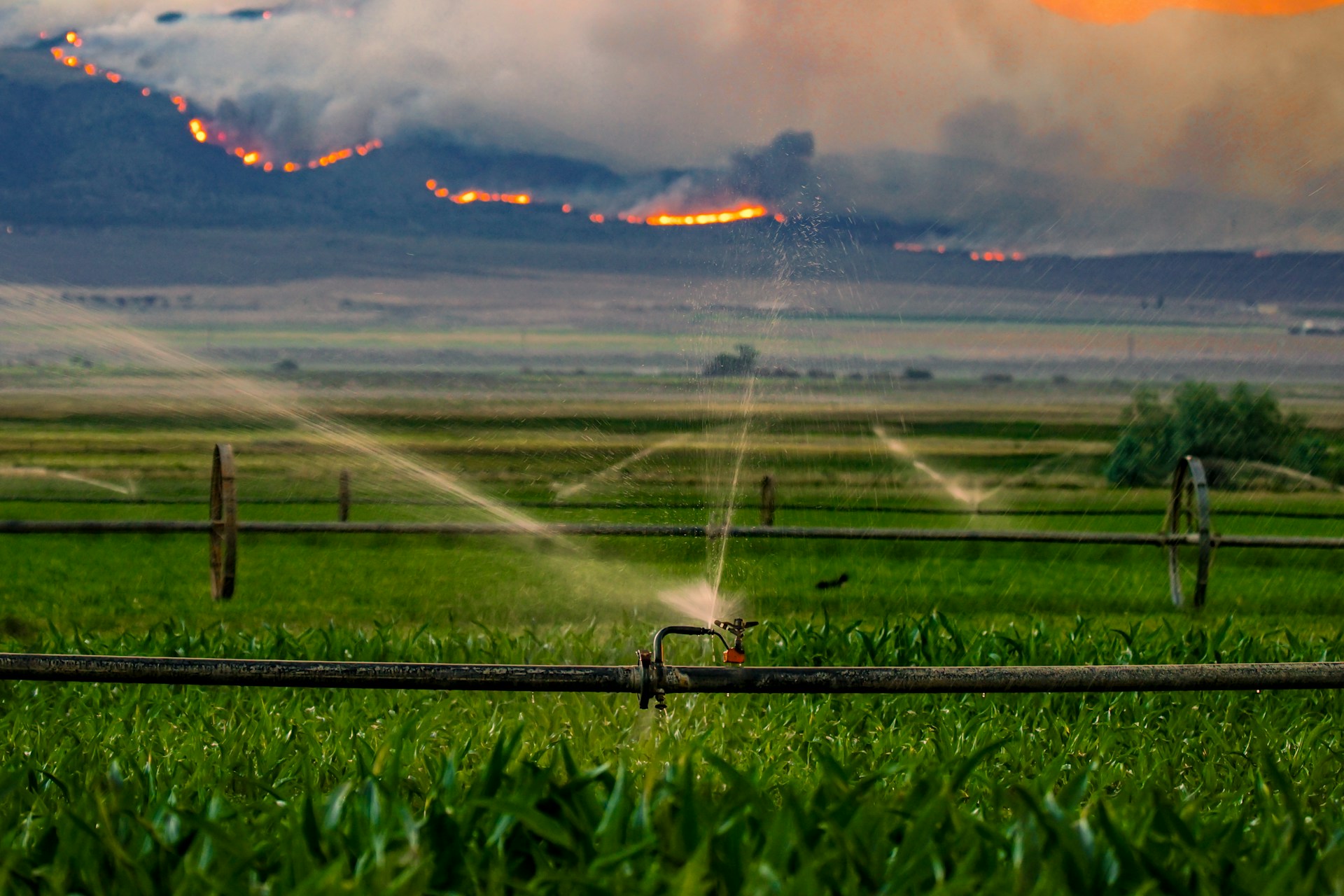
Across Utah, increasing water demand is forcing difficult decisions about how the state manages one of its most limited resources. The amount of water flowing into the Great Salt Lake influences far more than the lake itself. It affects the air people breathe, the severity of wildfire impacts, agricultural communities and economic opportunities.
A strained circulatory system
“The Great Salt Lake is shrinking because we are diverting its tributary rivers upstream of it excessively,” said Joe Roberts, advocacy marketing manager of Utah Rivers Council, a non-profit organization that promotes sustainable aquatic ecosystems.
“I like to think about it kind of like a circulatory system,” he said. “Water evaporates out of the lake; it snows in the mountains, and then that water should run to the Great Salt Lake after we’re done with it.”
Historically, the lake has covered roughly 1,700 square miles and supported one of the largest saline ecosystems in the Western Hemisphere. It provides habitat for millions of migratory birds, supports Utah’s brine shrimp industry and contributes to lake-effect snowfall in the Wasatch Mountains, which researchers estimate provides approximately 5-10% of annual snowpack in some areas.
The lake is a terminal body of water, meaning water only leaves through evaporation. But as inflows decline, water levels drop quickly.
As the lake reaches historic lows, state officials have implemented protections during periods of extreme water scarcity. Aspen Johnston, strategic coordinator for the Office of the Great Salt Lake Commissioner, said many protections are already active.
“There are mechanisms in place that try and protect the Great Salt Lake when hydrologic conditions are particularly unfavorable,” Johnston said.
One example is restricting mineral extraction when the lake reaches certain elevation thresholds.
“There is still water that’s being dedicated to the Great Salt Lake and being shepherded there by the state engineer,” Johnston said.
Even with these efforts underway, the shrinking lake exposes more of the lakebed and the dust it creates.
The dust we can’t ignore
As the lake shrinks, the potential for dust storms that can carry fine particulate matter into nearby communities increases. This dust can contain heavy metals and industrial contaminants including arsenic, lead, copper, mercury, selenium and uranium — all linked to adverse health effects.
Dr. Kevin Perry, an atmospheric sciences professor at the University of Utah who studies Great Salt Lake dust, says that health risks associated with airborne particulate matter are already well established.
“It doesn’t matter what the dust is made out of,” Perry said. “If the concentrations are high enough, then it can have an acute health response.”
The American Lung Association and Environmental Protection Agency both warn that dust particles breathed into the lungs can cause respiratory distress and a wide range of pulmonary and cardiovascular illnesses, including increased risk for certain cancers.
Even so, Perry said researchers lack enough long-term data to understand the full scope of the Great Salt Lake dust problem.
“We’re living in a world right now where we don’t have good enough data about the Great Salt Lake dust,” Perry said.
To address those gaps, Utah is developing a statewide dust-monitoring network that will measure both concentration and chemical composition. Perry said the network will help researchers better understand the risks and could eventually allow officials to provide public dust alerts.
“Everything in my scientific background tells me that the dust from the Great Salt Lake has the potential to be a significant health hazard,” Perry said.
Researchers have looked at other shrinking lakes, Owens Lake and the Salton Sea in California, for a glimpse at Utah’s possible future. Both exposed lakebeds have contributed to significant health concerns in surrounding communities.
Even though conditions at the Great Salt Lake are not identical, Perry believes the potential risk warrants attention.
“If the dust continues to get worse, it changes Utah from [having] kind of, seasonal air quality challenges to potentially year-round air quality challenges,” Perry said.
Fire and smoke challenges
Many Utahns associate air quality with winter inversions and summer ozone. But as water insecurity and dust increases, severe wildfire seasons create more challenges for Utah’s air.
This summer, Utah experienced two of the nation’s largest wildfires. The Cottonwood and Babylon Fires both contributed to a fire season that, so far, has burned 455,741 acres within the state — over six times the size of Salt Lake City.
“It’s becoming less accurate to think of wildfire as having a defined season,” said Kayli Guild, fire communications and prevention coordinator for the Utah Division of Forestry, Fire and State Lands.
Guild says increasingly dry conditions over recent years have contributed to a higher risk of wildfires throughout the year.
“In recent years, we’ve responded to wildfires in January — something that historically would have been much less common because of more consistent snowpack and higher fuel moisture during the winter months,” Guild said.
Who gets the water?
Utah remains one of the fastest-growing states, with the population reaching 3.5 million in 2025. Most of that growth is concentrated along the Wasatch Front.
Utah is also home to over 17,000 farms and agriculture accounts for roughly 82% of water withdrawals, largely used to irrigate alfalfa and other feed crops.
Alfalfa makes up 80% of Utah’s irrigated cropland. Although alfalfa grows well in Utah’s climate and provides sustainable winter feed for cattle, it routinely consumes over half of all diverted water.
Concerned citizens and researchers have called for a decrease in Utah’s alfalfa farming, but Aspen Johnston, strategic coordinator for the Office of the Great Salt Lake Commissioner, says it’s not that simple.
“Rarely do you see a way to save water that does not have some sort of negative impact on somebody’s livelihood or well-being,” Johnston said. “It’s easy for the problem to be seen as something that can be solved simply … but when you get into the work, you realize these are really complicated situations.”
Utah has focused on voluntary conservation programs, including water leasing, which allows farmers to lease a portion of their water for environmental restoration. They receive compensation without risking their water rights.
New pressures from data centers
Recent legislative sessions have also addressed water consumption for growing industries. In 2026, the Data Center Water Transparency Amendments passed, making Utah the first state to require new data centers to report projected and annual water usage.
This comes as the Stratos AI Data Center in Box Elder County has sparked a national conversation over the industry’s environmental impact.
Project developers promise to run on a closed-loop cooling system and rely on groundwater and not divert from homes, farms or the lake. However, groundwater still plays a role in the lake’s inflows. An estimated 10% of the Great Salt Lake inflows come from groundwater which helps keep soil moist, reducing toxic dust.
Critics of the project argue that groundwater use alone could impact water availability for residents.
Homeowners’ responsibility
Municipal and industrial users account for about 15% of Utah’s diverted water, and much of that goes toward lawns and gardens.
“Utahns are the country’s biggest water wasters,” said Roberts.
A 2015 study ranked Utahns among the top municipal water users in the country.
“There’s no reason people need to be growing Kentucky bluegrass in the second driest state in the country,” said Roberts.
Johnston echoed the statement.
“Homeowners are growing an alfalfa of their own,” he said. “From a farmer’s perspective, that’s growing a crop of grass, harvesting it and throwing it in the garbage.”
The state encourages residents to embrace practices like watering lawns at night, planting water-wise gardens using native plants and xeriscaping to conserve water. Lawn and garden irrigation account for as much as 65% of annual municipal water use. Utahns could make a large dent in water demand simply by changing what they grow.
How else can Utah change course?
Utah has already begun taking steps to address its water challenges. The Great Salt Lake Strategic Plan calls for conservation across all sectors. Efforts such as agricultural optimization, turf replacement, water banking and dedicated water aim to reduce demand and keep more water in the lake.
Recent legislation has also made it easier to dedicate water to the Great Salt Lake with expanded programs for water leasing, dedicated water and agricultural conservation while continuing efforts to improve water efficiency and planning.
“The suite of legislation … to allow for the legal dedication of water to the Great Salt Lake is huge,” Johnston said. “What we really need is additional financial resources.”
The state has made progress. The Office of the Great Salt Lake Commissioner says more than 288,000 acre-feet of water have been dedicated to the lake that was not dedicated three years ago, and there are now hundreds of agricultural optimization projects.
But the challenge is ongoing. The population is growing, temperatures are rising, and water demand is increasing. Changing how Utah uses water will require continued investment and participation from everyone.
Still, Roberts said Utahns should remain optimistic.
“This is not a hopeless situation,” he said. If people get activated and they show up and they speak out … the people can still be heard.”