Editor’s note: Although this bill passed the House, it failed to get Senate approval before the legislative session ended.
Week six of the legislative session ended with a passionate debate before the House passed a bill which adds new citizenship requirements for in-state tuition and other state benefits.
HB 386, Immigration Amendments, sponsored by Rep. Lisa Shepherd, R-Provo, aimed to repeal 2011’s Guest Worker program, which was never adopted in Utah and faced repeal efforts from Utah County.
House debate triggers three tie-breaking votes
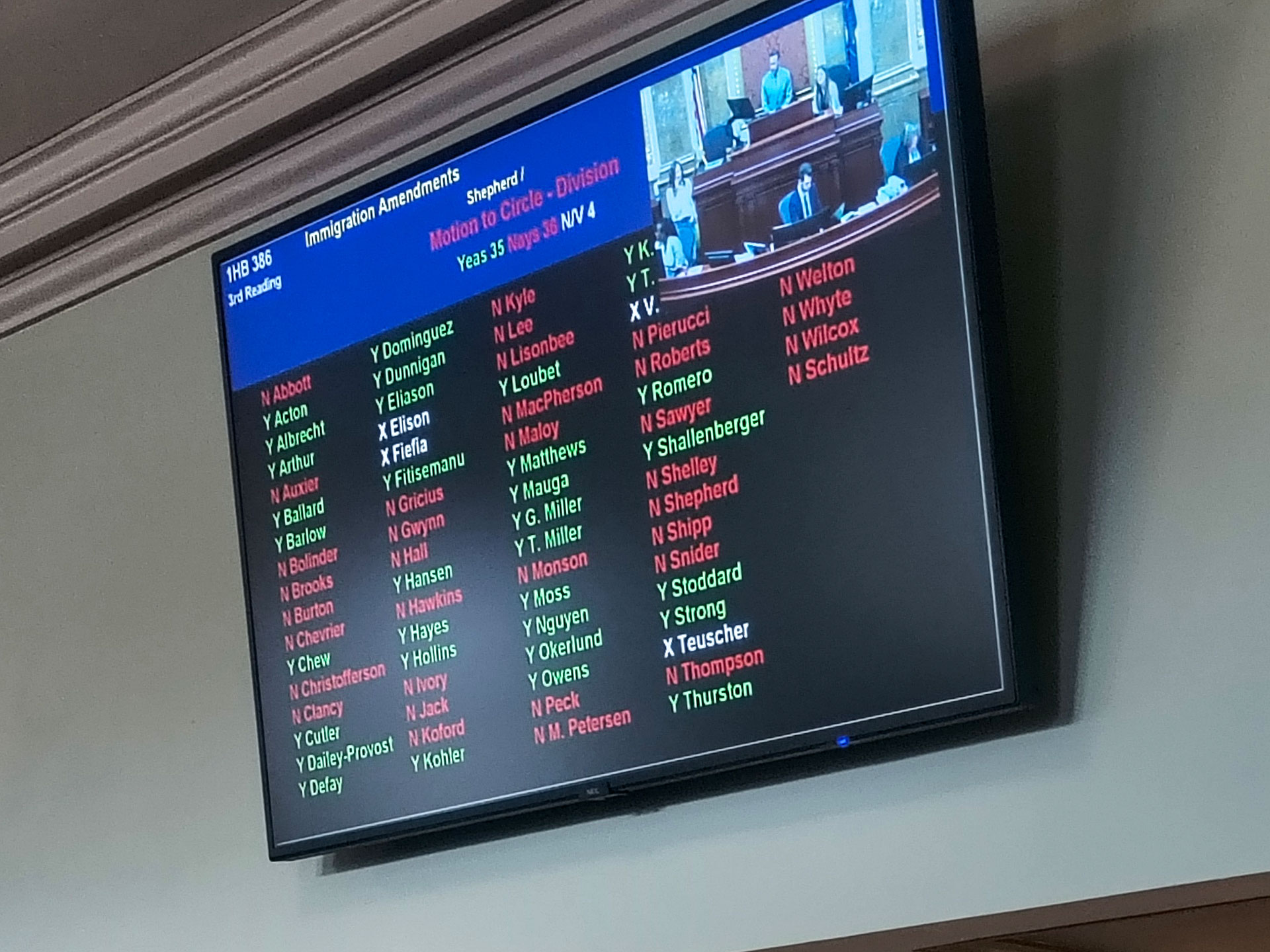
For the first time in the 2026 session, a call to House, which allows voting to continue until all members vote to break a tie, was in motion in multiple rounds of voting regarding the substitute bill, holding the bill and voting to allow HB 386 to continue to the Senate.
Relatively early into the presentation of HB 386, Rep. Trevor Lee, R-Layton, placed a second substitute on the bill, adding specifications such as requiring proof of citizenship for state retirement, housing, tuition and licensing.
Rep. Jennifer Dailey‑Provost, D‑Salt Lake City, said the move seemed like an attempt to insert HB 88 Public Assistance Amendments, sponsored by Lee, into HB 386.
“I am deeply opposed to HB 88 and offended that this bill would be substituted into another bill,” said Dailey-Provost, “This [substitute] all hinges on citizenship and makes no concessions for people who are in the process of applying for citizenship and in the process of doing everything we ask them to.”
What HB 88 aimed to do and what changed in HB 386
Lee’s HB 88 was killed by being held in “jail” after being circled following last week’s heated debate in which both Democrats and Republicans opposed it. The bill would have required proof of citizenship to receive locally funded public assistance programs.
Through Lee’s substitution on HB 386, the new bill would override long-standing Utah requirements to receive in-state tuition from 2002’s HB 144, which allows undocumented students to qualify for in-state tuition if they attended a Utah high school for three or more years, graduated or earned a GED in Utah, and signed an affidavit promising to seek legal status. Under HB 386, immigration status becomes a disqualifier, leaving student immigrants without documentation to pay out-of-state tuition which can be three times higher.
In both arguments for HB 88 and HB 386, Lee stated the legislation benefits Utah taxpayers. However, Rep. Raymond Ward, R-Bountiful, questioned who would benefit if students had to drop out from lack of affordability.
“Many of those students would have to drop out of school because they would no longer be able to afford it,” Ward said. “If those folks cannot go to school, what other group of people do we expect to benefit from that? It’s not clear to me what other money would replace that, so that would then be a loss of money to the state.”
Ward noted that both students and the state would lose money.
Representatives give personal testimonies on potential effects
In an emotional testimony, Rep. Hoang Nguyen, D-Salt Lake City, told her American dream story, one she said she usually prefers not to share unless she is asked. She described the loss of her father, her mother raising them on public assistance programs, and how she and her siblings had the ability to afford higher education despite their hardships.
She argued that while her family’s path to citizenship is what is considered the “right way,” she thought about the other children she grew up with who struggled to achieve citizenship but came here with the same dreams as her.
Nguyen made Utah history by becoming the first Vietnamese and refugee woman to serve in the legislature in 2024. Although she said she is proud of her accomplishments and to be a part of Utah, she spoke on the “Utah way” of supporting neighbors.
“By subbing in these substitutes, I would not have been able to go to college, my mother would not have been able to buy that house on the west side …” said Nguyen. “I fear what we’re doing here in Utah, is [that] we are eroding what truly makes Utah special … we are starting to adopt policies that are regressive and don’t take care of people.”
After an emotional debate, Rep. Norm Thurston, R-Provo, tried to hold the bill, stating the House needed clarity on its intent. He said lengthy discussion with the drafting attorneys did not make it clear to him whether the bill would potentially make it easier or harder for undocumented students to receive in-state tuition.
“If you’re going to vote on this bill … you better figure out for yourself whether you’re voting to make it easier or harder for those kids,” Thurston said.
Before the substitute was adopted by the House, in a narrow 39-33 vote, Lee gave his final thoughts.
“I just wanna clarify that if you’re a legal resident, this would not apply to you,” he said. “And I believe the bills [are] very clear on that.”
As arguments over the substitute bill resumed, Rep. John Arthur, D-Cottonwood Heights, told his personal story of becoming not just a resident, but a Utahn. He said this bill, in his mind, aimed to repeal that identity for many students who were brought to Utah often when they were young and without a say in the matter.
“We should not be cutting out any group of Utahns; we should be embracing and elevating,” Arthur said.
After lengthy debates, the House passed HB 386 allowing it to continue to the Senate.
In final comments, Shepherd, the bill’s original sponsor, said federal immigration policy creates incentives for undocumented residents to stay in the state without legal status by allowing access to certain public assistance programs. She said HB 386 ensures state resources go to Utah residents.
“We’re taking care of other country’s children first, and I want to take care of Utahns first,” Shepherd said.