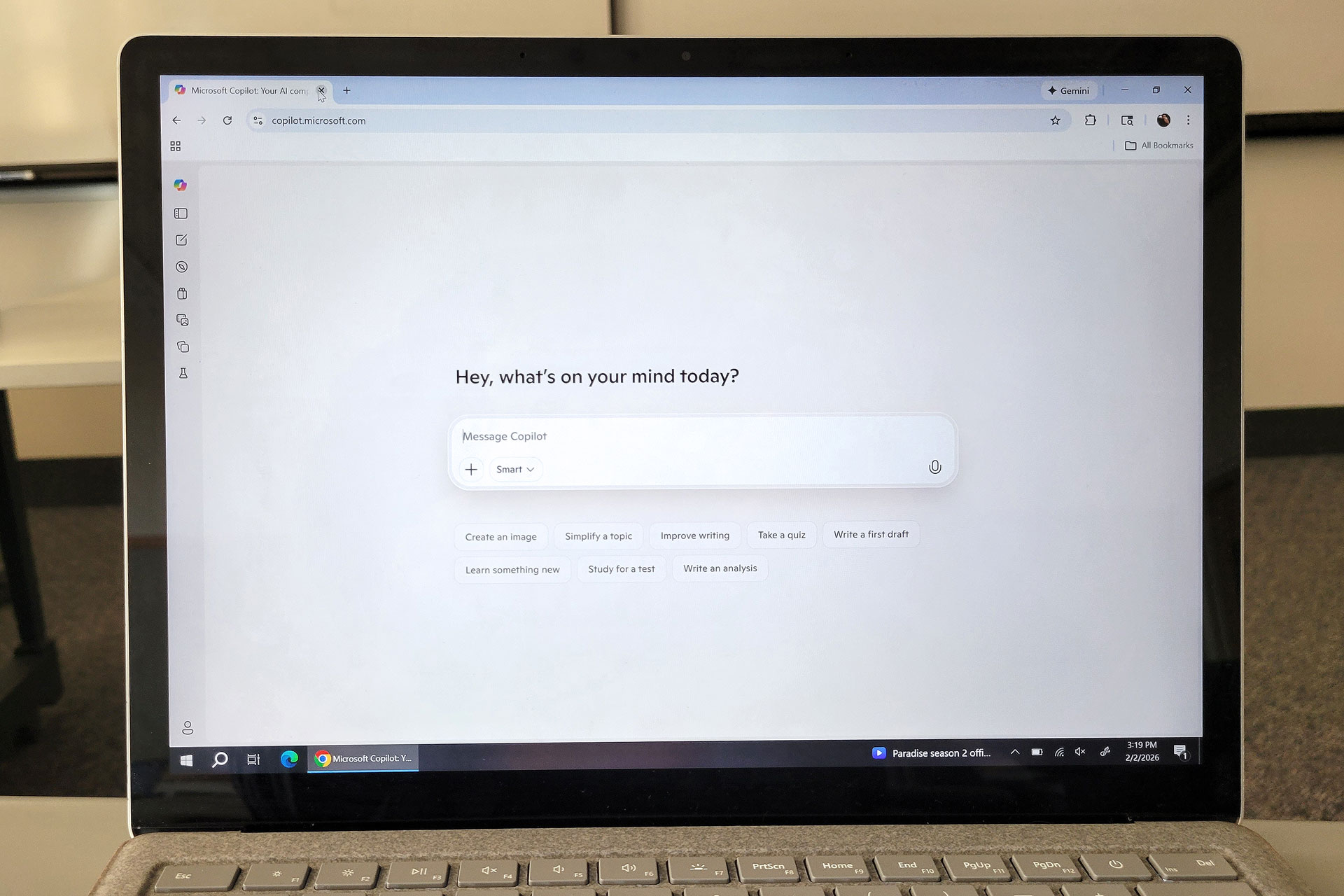
Salt Lake Community College students and faculty share whether they use GenAI and their thoughts on it, showing both support and opposition to this type of technology.
Generative AI, also called GenAI, is a type of artificial intelligence that uses generative models to create new content such as text, images, videos and more based on the user’s prompts.
In recent years, GenAI’s adoption rate has grown in the U.S. with over 50% of adults using it. The technology has even made its way into education, where both students and teachers are using this tool to support learning and teaching in the classroom.
What students are saying
Sarah Mendivil, an SLCC student studying health science, says that she uses GenAI for both her classes and personal life.
“When I’m struggling in a subject [like] math, or English, I like to use ChatGPT so [it] can teach me how to do a step-by-step or if I don’t know [the meaning of] a word,” she said. “I think it’s really useful right now for everyone.”
A study of over 1,000 U.S. college students found that students tend to seek help with academic tasks in two ways: instrumental help-seeking, where the person understands the concepts and processes; and executive help-seeking, getting direct answers with less effort.
The study showed that students often used instrumental help from GenAI at roughly the same rates as other sources such as instructors, tutors and peers. However, students seeking quick, direct answers were most likely to use executive help from the internet and GenAI sources.
TJ Wilde, an SLCC animation major, voiced ethical concerns about the use of generative AI.
“I can see its benefit, like getting a rough idea down, but a lot of the ways that it is being used, I feel like it shouldn’t be used for,” said Wilde. “Specifically, like making art. [It is] not making anything new; it’s just mashing up all the random things artists have made together.”
AI-generated art is generated from datasets such as photographs, paintings, and other artworks created by humans, which AI uses to learn and recognize patterns and styles to produce new artwork based on prompts from individuals.
ESL students, such as Diana Garcia, a journalism and digital media major whose first language is Spanish, said GenAI tools such as ChatGPT help translate texts into English.
“I do use AI, especially when I have an idea, and I need to clarify the idea that I have,” said Garcia. “Sometimes, it can be hard to translate an idea to [English]. So, for me it’s helpful if I can write my ideas in Spanish, and be like, ‘Hey, how will this idea work in English?’”
What the faculty are saying
In a recent study of over 1,000 U.S. higher education faculty, the majority said they do not use AI for teaching, learning, or research. Twelve percent said they use AI for teaching and instructional activities, and 34% said they use it only a little.
“I do not use AI at all for anything,” said Julie Roberts, an English professor. “I’m not saying that I wouldn’t in the future, but I don’t feel a need to. A part of it is that I’ve been teaching for so long that I haven’t found it necessary to use it.”
Ken Hansen, a history professor, has never needed to use AI for his teaching or classwork, but says that Copy Leaks, an AI tool that detects AI-written content and plagiarism in Canvas, has proved helpful in grading his students’ papers.
“Whenever you submit something through Copy Leaks, they go to AI and pick up the database, and they will then reflect that by the scoring that I see when I start to correct the paper …” he said. “Green is okay, yellow is a warning, red is a bad situation … It gives me the ability to discern how well my students are writing.”
Antonette Gray, who teaches criminal justice, does not use GenAI for any teaching or classwork, but she has started experimenting with it.
“Initially, I was very averse to anything GenAI,” said Gray. “As someone who writes a lot, I hold rigor and standard to a place that is ethical.”
After having a conversation with a colleague, she decided to try Microsoft Copilot for the first time to polish one of own writings and make it sound more academic.
“When I got the results, I was amazed at what I got,” said Gray. “I was like, ‘Okay, well, it only did exactly what I asked it to do … there’s something to this.’”
Concerns and recommendations for GenAI
The impact of GenAI on students in higher education has led to many concerns, especially among U.S. educators.
According to the American Association of Colleges and Universities, 90% of faculty say AI will diminish students’ critical thinking skills and 95% say it will increase their reliance on such tools. Faculty also acknowledge potential benefits, with 61% believing AI could enhance learning in the future and 27% saying that GenAI tools will have a positive impact on student learning outcomes in the next five years.
Gray expressed caution about student use of AI in the classroom, saying overreliance is not in their best interest, and that it is up to “the user and not the actual media.”
“I think the tool is good,” Gray said. “But, as with anything else, we have access to [information] that might become inclusive or exclusive; we just have to be responsible, we have to be ethical, we have to be accountable for the information that we furnish.”
Likewise, Hansen expressed concerns about overreliance on AI and how it cannot replace a student’s thinking.
“Doing research is wonderful using AI, but being able to validate what you’re writing, it needs to be your words,” said Hansen. “AI will put things in there for you; it will lead off a sentence, it’ll help you create a thesis statement, but it doesn’t do the analytics. That’s where the human mind comes in.”
SLCC does not have an institutional AI policy, but individual classes and instructors have specific guidelines on how to manage it in the classroom.