
For years, sports broadcasting has been seen as a male-dominated arena. But women are steadily carving out space within the field.
On camera, behind the mic and inside production crews, that shift is happening everywhere from Salt Lake Community College’s media classrooms to the Utah Mammoth’s broadcast booth.
Nationwide, women remain underrepresented in sports broadcasting roles. The Forward Pathway found that 83% of the sports media workforce is male, and recent data shows that opportunity is not evenly distributed across platforms.
According to the Boxed In report by researcher Martha M. Lauzen, women made up 36% of creators on streaming programs in 2024–25, a historic high; while women’s representation on broadcast programs remained stalled at 20%, highlighting continued barriers in traditional broadcast spaces and the lack of representation that shapes which stories get told and whose voices are amplified.
What about locally?

Kim Becker, broadcaster for the Utah Mammoth, said entering the industry meant preparing twice as hard and showing persistence in a space where women historically weren’t expected.
“Sports broadcasting has always been about passion,” Becker said. “But as a woman, you also have to prove that your knowledge and preparation are just as strong, if not stronger, than anyone else’s. It’s about earning respect through your work.”
At SLCC, instructors say they’re seeing that shift with the students pursuing sports broadcasting.
“Our program is really hands-on,” said Matt Merkel, associate professor of video and radio production at SLCC. “We’re not just sitting behind desks; we’re in the studios, producing, editing and directing. It’s practical training, not just theory.”
Merkel, who has spent more than 16 years teaching production at SLCC, said more women are stepping into advanced roles across the pipeline.
“We’re seeing more women not just on camera, but directing and producing,” Merkel said. “You’re seeing more TV trucks filled with women than ever before. It’s a great thing to see.”
Still, he said some industry barriers remain.
“There’s still an old guard, some gatekeeping,” Merkel said. “For every guy who gets a story published, the woman often has to work twice as hard. It’s not perfect yet, but it’s better than it’s ever been.”

Brittni Johnson, now a reporter for East Idaho News, said her start in broadcasting began at SLCC, where she first realized sports media could be a real career path.
“I’ve always loved sports,” Johnson said. “In junior high, my counselor told me I could never be a sideline reporter. That motivated me to prove her wrong.”
Johnson said early mentorship helped her advance quickly.
“Zac Hodge and Matt Merkel were extremely helpful,” Johnson said. “I have them to thank for everything.”
Johnson said internships were key as she juggled classes, work, and newsroom duties.
“I was a full-time student, doing sports editing for the school newspaper, working a job and interning,” she said. “Internships were just super helpful. You get hands-on experience, and you make connections. It helps you not feel like the newbie anymore.”
Johnson said women entering the field still face doubt from others.
“A lot of times I felt like people didn’t take you as seriously,” Johnson said. “I constantly had to remind myself that I belong at the games, at the press conferences, just as much as a man.”
Ty Weeks, a technical director at KSL and longtime sports cameraman, including covering KSL’s high school sports broadcasts, said he’s also seen a significant rise in women working production roles.
“When I started, there was basically only one woman teaching me camera work,” Weeks said. “Nowadays, it’s not uncommon for me to be the only guy in the room.”
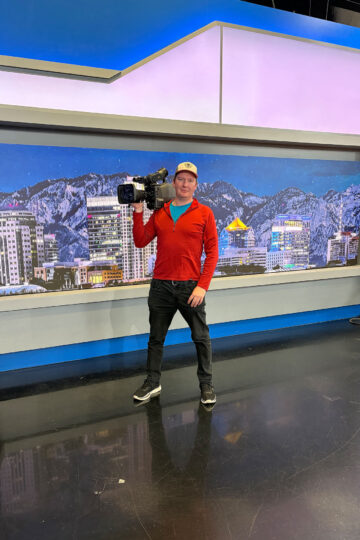
He said the biggest increases are happening behind the scenes.
“For every one or two women you see on camera, there’s probably double that increase behind the camera,” Weeks said. “It’s a cool trend, especially with the growth of women’s sports coverage.”
Weeks said skill expectations are the same regardless of gender.
“In terms of technical skills, cameras, graphics, it’s all the same,” he said. “Men or women can do it equally well. But yeah, there might be a heavier expectation put on women, especially covering men’s sports, mainly from old-fashioned viewpoints.”
Weeks said SLCC students hoping to enter sports broadcasting should take every opportunity that comes their way.
“Say yes to any opportunity,” Weeks said. “Even if it’s not exactly what you want to do. The more you learn, the more skills you gain.”
Becker said visibility plays a major role in motivating women to consider the field.
“When women see other women doing it, they realize it’s possible,” she said. “It gives them permission to take up space and tell stories that matter.”
As SLCC continues preparing students for broadcast roles, Merkel said the momentum is growing.
“Right now is a really good spot to be for women in this space,” he said. “They have a strong voice, and the opportunities keep growing.”
Students interested in SLCC’s video and radio program can visit the school’s website for enrollment information and program details.
Editor’s note: This story has been updated to correct a photo caption.