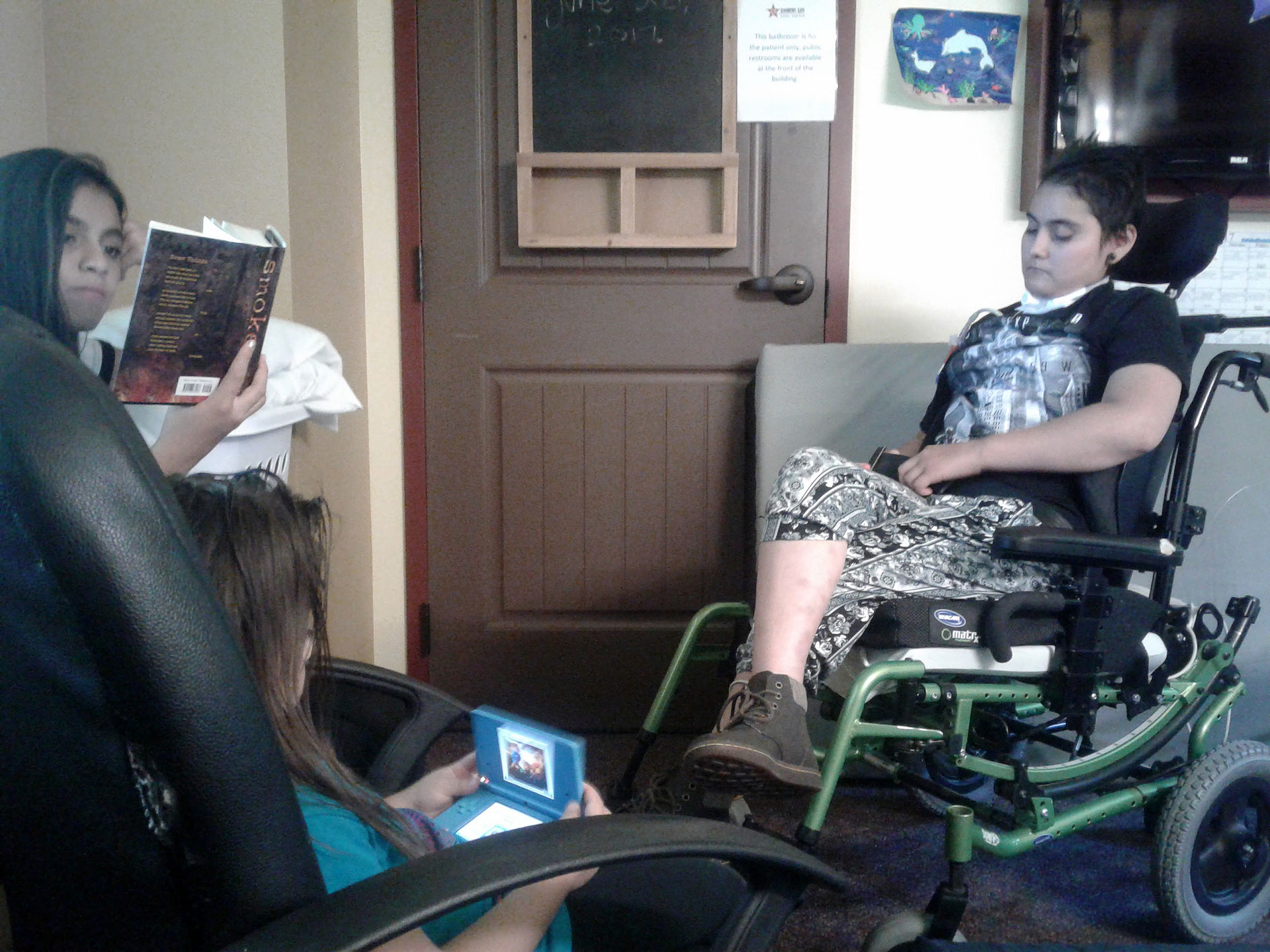
My sister was 25 when she suffered an anoxic brain injury and wound up in a coma for several months. My family still isn’t sure what led to her being in the hospital or what went wrong, other than being given excess sodium which resulted in a traumatic brain injury during the routine intake exam after being given electrolytes.
For four years, we took care of my sister, navigating the systems in place and struggling to understand what rehabilitation meant for her.
There were many aspects we didn’t understand, tasks I wasn’t formally trained to do, but learned out of necessity to help keep my sister comfortable and give her the best quality of life we could.
She lived in four different nursing homes over the span of three years. Often, we were the only family who showed up, day and night, day after day.
Delmy was nonverbal and required a lot of rehabilitative therapy. Most of the time those tasks were left up to us due to lack of resources and assistance.
I was barely 18 and I had just moved out with my sister when she went into the hospital. I had been figuring out what I was going to do going forward with my life and how to navigate the adult world of rent, bills and full-time work.
My parents and I maintained full-time jobs while also balancing taking care of my sister. My life revolved around either being at work, helping with my other two little sisters, or helping the nursing staff with Delmy.
Our experience isn’t unique; millions of families experience this every day. Across the U.S., family members become caregivers to loved ones often without pay, respite or training.
The hidden costs of caregiving
In 2023, the estimated economic value of these contributions was $600 billion, totaling 36 billion hours of care and in 2025, there were 63 million people acting as family caregivers, according to USA Today.
An AARP survey, “The Cost of Caregiving,” reported 56% of family caregivers said their role made it difficult to care for their own mental health. Additionally, 41% reported feeling lonely and 36% found navigating systems like Medicaid waivers and longer-term care services a “significant challenge.”
This was the reality for my family; we struggled to find rehabilitation services and nursing homes that could provide my sister with what she needed. At one point, my parents had no other option but to allow doctors to remove Delmy’s trach before they thought she was ready. No care facilities were close enough to drive to that had specialized care, and we didn’t have the resources to hire home nursing staff.
“[Caregiving is] a daily reality that 63 million Americans shoulder every day,” said Jason Resendez, president and CEO of the National Alliance for Caregiving in an article for the AARP Press Room, “When nearly 1 in 4 adults are providing complex care with virtually no training and more than 13 million struggle to take care for their own health while caring for others, we cannot continue to treat family caregiving as invisible labor. It’s past time for a national reckoning with how we value care in this country, and for Congress, states, and employers to act with policies that reflect the essential role family caregivers play in our society.”
Systemic challenges
A systematic review on caregiving policies, found challenges caregivers faced relate to equity, with low-income and marginalized families being hit the hardest.
The same research found that services including respite care, culturally and linguistically appropriate caregiver support, transportation and financial assistance were used less by vulnerable populations, leaving them with fewer resources.
Despite existing policies aimed to help caregivers, only 14% of caregivers in the U.S. reported using respite care. Even among those who received Family and Medical Leave Act benefits or other supports, many caregivers still reported gaps in knowledge and access.
The line between medical and emotional care
A nurse by nature is a caregiver, although I could argue that the work is too much to be handled by a single nurse and one CNA. During our time in facilities, often the responsibilities of a single hallway –which was usually around six patients – landed on one nurse and two CNAs, and at times only one CNA.
Often, patients were sitting alone in their rooms, waiting for their hourly check-in. The lack of CNAs often led to patient call lights blinking for hours before someone responded.
A lot of patients didn’t have a family like my sister, who came and helped out. Even though there were nurses and CNAs, my family often carried out a majority of duties, very rarely relying on staff to come and do what was needed. We handled brief changes, daily hygiene, dressing her, and helped feed and administer medication.

A call for change
The care facility industry is overdue for reform. Those receiving care need attention, specialized care and advocacy.
A 2024 report on the state of caregiving found that 73% of caregivers said they would be more likely to support a political candidate who advocates caregiving policies and programs.
There must be a way to bridge gaps in the caregiving system to no longer leave family caregivers like mine to navigate these medical systems alone. Too often my family faced language barriers, insurance barriers, or lack of support when we tried to find better options.
My family was never trained to do these tasks, and we did them out of love, but caregiving can no longer be invisible labor. Praise for the love and care provided for family members can no longer be enough when the system leaves so many of us struggling to maintain our health while providing for our loved ones.