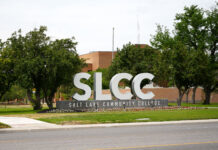
As the United States faces a critical shortage of certified American Sign Language (ASL) interpreters, Salt Lake Community College is working to meet the growing demand.
There is roughly one interpreter for every 50 people who need the service, according to the Commission on the Deaf and Hard of Hearing. SLCC has a program to help fill the gap in the field of ASL interpreting.
The Interpreter Training Program (ITP) takes about 12 students each fall. It’s an intense, two-year course designed to prepare students for the Utah Certified Novice Interpreter exam, explained Connie Spanton-Jex, the program’s director since 2002.
Program changes lead to student success
Spanton-Jex said there have been many changes to improve the program in that period. In 2011, the first thing addressed was class sizes.
“You’d start with 60 students and by the end you had 12, right?” she said. “It was a huge group, and there was a day and night program. The college didn’t like those, so we changed, and only take 12-14 [students] in a year.”
Students also struggled to complete certification, even several years after completing the program.
“It’s important that students graduate from your program, and that they certify,” Spanton-Jex said. “We now have a 70% certification rate on the first attempt at taking the test.”
Once an interpreter earns the certification, they can apply for work. However, Spanton-Jex recommends that new interpreters continue to hone their skills and gain higher levels of certification before working in more challenging environments.
She said the program’s current success stems from the individual attention each student receives in class. Elizabeth Silver, a second-year participant in the program, said that it made a difference in her success.
“I like how each professor seems to care about me, as a person, and takes time to like, work with me when I’m [having] trouble understanding things,” Silver said.
Carmen Harrison graduated from the program last May. She had a similar experience.
“I felt like I was seen by most of the professors, and the language lab was really helpful, too,” she said. “I drove all the way from Clinton to attend these classes, because they made them engaging.”
Alternative pathways to certification
Even with improvements to the program, around 30% of students won’t pass the certification test on their first try. Spanton-Jex said there are options for students when that occurs. They can take additional classes and online workshops or pursue community continuing education programs to continue improving until they pass.
Harrison chose one of those options and is currently completing a program that will allow her, once she passes, to earn a certificate to interpret in specific settings as a steppingstone to a general certificate.
“I’m in the EIPA (Educational Interpreter Performance Assessment) program so I can start interpreting in the school settings,” she said. “Of course, I can interpret in religious settings, and I immerse myself in deaf culture as much as possible.”
Practicum challenges
Spanton-Jex said it would be wonderful to provide opportunities for more students to join the program, but it can be difficult to arrange practicum opportunities to finish their studies.
“They need mentors who are willing and able to work with practicum students,” she said.
Spanton-Jex said the greatest obstacle is finding interpreters to take on someone who is just learning. Most of the time, students only have elementary and secondary education settings. This means they also need to get permission from the parents and the students the trainee will be working with.
“Obviously this is the challenge that we are facing at the moment,” she said.
Still, Spanton-Jex said the program is thriving and giving the community some sorely needed support. Silver agreed, explaining how important interpreting is for the community, and her personally.
“I love being part of the deaf community,” Silver said. “I can’t wait to graduate and help as much as possible.”
Visit the program homepage for more information.